Today, we are going to talk about learning.
It’s one thing to suggest a bunch of books; it’s another to revamp how you learn and apply what you’ve learned.
As you read, you’ll see that the reason I believe many authors don’t get the results they seek is they apply what they learn from others but don’t have their own method of going into deeper learning where novel ideas develop.
What is Bloom’s taxonomy?
In the past, I’ve shared my appreciation for systems thinking advocate Dr. Ackoff. It was in his work that I first saw his hierarchy of Data, Information, Knowledge, and Wisdom. The issue is that he doesn’t talk much about how to move from blind application to wisdom.
That is where the Bloom taxonomy can help.
Bloom’s Taxonomy of Learning is a hierarchy of learning types. Its purpose is to help test designers evaluate the kind of learning a test taker has achieved.
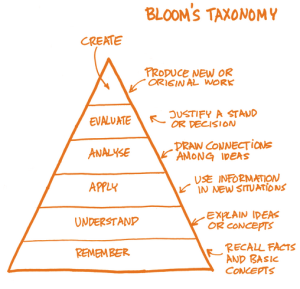
The bottom of the pyramid is Remembering. This base level of learning is the capacity to regurgitate information you have memorized. While you have this knowledge, it doesn’t translate into anything more than a spelling bee win or dominating Jeopardy.
The next level is Understanding. Understanding is the ability to classify, locate, or explain an idea or concept. You take what you remember and give it context within other things you remember, but this still doesn’t result in action.
At the third level, Apply, you use this knowledge in a way that gets results. This third level is where you can solve problems, implement concepts, identify, and interpret. Most people stop at this level because it is when we can apply knowledge and get a result.
I, and maybe you, have fallen prey to stopping here. I learned how to do something like run an advertisement and then went and did it. However, the ability to run an ad doesn’t mean I understand what drives a marketing campaign.
We go to conferences and see someone who has had success who says it is because of the process they espouse.
Is it?
A need for results drives us to learn this process well enough to apply it, and then we may or may not get results.
We never stop to ask if the person teaching us has a deeper knowledge beyond Application; we just take their word that the Application is the cause of the effect we desire, then follow suit and only learn that process.
Application is only 50% of the journey. Remember, the Taxonomy is a means to evaluate competency and true learning; therefore, there are three more levels beyond Application.
To show deeper learning, you must demonstrate Analysis, Evaluation, and Creation.

This aligns with Shuhari, the Japanese concept of learning, in which one learns the tradition, then breaks with it, and finally transcends what was.
When you think you’ve tried everything, you immediately show that you haven’t. That feeling is a symptom of endless Application but a lack of Analysis, Evaluation, and Creation.
Practical applications in the publishing industry
Let me give you some examples to help you find where you may be able to go beyond Application.
Can you examine the return on investment for various marketing expenditures and identify which investments have the highest return?
Can you break down the elements of your author brand to determine which aspects resonate most with your audience?
Can you assess the elements of craft and story structure across your books and associate those elements with improvements in customer experience (i.e., reviews, ratings, and sales)?
Do you see how these questions begin to challenge you in different ways?
A big part of the issue faced in our industry isn’t your capacity to learn but how you educate and apply yourself. I’ve thought a lot about this while working with the team on programming.
We have a systemic problem of adoring results and never Analyzing, Evaluating, or Creating our own system.
We Frankensolve. Like the famous doctor, we stitch together what we think drives results and animate it.
Frankensolutions aren’t systems.
They lack the critical design and wisdom that comes from higher levels of learning and systems thinking.
Author Nation: A case study
Take Author Nation as an example.
We could merely mimic what other successful shows do.
Instead, we are Analyzing, Evaluating, and Creating a new system.
This extends beyond mere criticism. I could observe a show and say I dislike a certain aspect, so we won’t do that, or I like another aspect, so we will do more of that. But this approach also leads to Frankensolving.
Instead, we start with the system’s outcome: a community of authors integrated with a community of readers. This is something we can Evaluate both quantitatively and qualitatively.
Are you prepared to go through the process that results in you creating a new way of succeeding at publishing?
There is a big gap to cross between learning from others how to apply best practices and analyzing those practices, evaluating them, and creating something new.
I’m writing this at 6:30 am. I’ve been up since about 5 am today, not because the early bird gets the worm or I push a hustle mentality, but because I’ve been working on respecting circadian rhythms. I spend more time this early taking care of myself than doing work. As a result, my work gets better. These behavior changes come from learning about quality of life and health.
Within my learning, there is mostly Application. I take what sounds like a good idea and try it. If I get a result like better sleep, mobility, or mood, then I keep doing it. If I want to go beyond a Frankensolution and build a system, I have to go beyond the first three layers of learning to Analyze, Evaluate, then Create a new method for my situation.
This process connects with the idea of 10x versus 2x.
When you aim for 2x, you Frankensolve. When you set out for 10x, you need systems thinking.