This week, we will discuss The Balanced Scorecard by Robert Kaplan and David Norton. The book is another classic business book from around the same time as The Knowing-Doing Gap, and I think it is part of the solution to solving the knowing-doing gap. It’s a dry read; I wouldn’t expect you to dive into it. However, it was one of the first places I was introduced to systems thinking, and discovering systems thinking was one of my biggest learning moments. What is a Balanced Scorecard?A Balanced Scorecard is an enterprise scoring system that integrates your business strategy to encourage constant improvement while maintaining balance. The big takeaway isn’t to have an endless spreadsheet of Key Performance Indicators (KPIs) but to have a complimentary few that result in a compounding effect. The areas of focus are:
- Financial: The results for shareholders
- Customer: The results for customers
- Internal Processes: How you deliver your products or services
- Learning and Growth: How your team improves over time
When a Scorecard is designed well, each point feeds into the other. While financial goals are the purpose of your business, customers and internal processes need to support those goals to make them happen. The last and maybe most important area is how the organization’s learning and growth support the other three areas. I want to build out a system that uses the ideas of the Balanced Scorecard to give me that dashboard, but I know that big strategic numbers are slow to move and don’t give you traction and guidance in the present. Where my brain goes is how the Balanced Scorecard can be the backbone for your Game of Cults game path recipe. What if these two ideas could be married together, and the Balanced Scorecard became the dashboard to guide your business, but game paths did the heavy lifting in the present? All too often, I hear authors say, “Tell me what to do, and I’ll do it.” That statement shows the willingness to do the work to achieve the objective but a lack of knowing how (The Knowing-Doing Gap). This gap results in doing anything and everything that someone suggests or pops up as the new hot thing. Your Scorecard simplified should be the big picture that drives the business. The numbers here change slowly, annually or, at best, quarterly. As you’ll see, the real takeaway is how thinking about these big numbers sparks ideas on how to achieve them. A Balanced Scorecard is too slow to motivate and guide daily work, but it does help you think about the work that is necessary in the present. What if we could build automated self-optimizing processes that support the big numbers? I imagine that the Game of Cults game paths are designed to implement activity and guide behavior and are connected to deliver those big Balanced Scorecard numbers. A case study: Author NationI’ll use Author Nation as an example. Let’s say one KPI on my financial Scorecard is increasing revenues. Just like you want to increase yours. Pay attention; this is where things are very different! The most common measurements of customer revenues are cost of acquisition, average order value, and lifetime value. These are not on-brand and are intrinsically transactional. I’ve chosen revenue growth as a financial measurement, followed by three for the customer: reader attendance, RAVE gross book sales, and author satisfaction. See the Scorecard below.
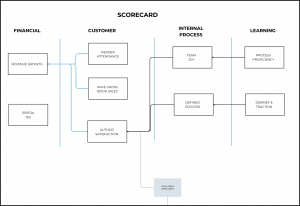 Why? Readers are an important customer segment. If we can increase reader attendance, authors will have an increasing pool of people to connect with and sell books to. This network effect benefits everyone. While writing this, I thought we could focus on getting it so that Author Nation wasn’t an expense to you but a source of revenue. Can we get it so an author sells enough books to cover all the expenses of going to the show? That idea only came out of the process of thinking through the Balanced Scorecard. Another measure is RAVE gross book sales. This may seem strange since Author Nation won’t profit from book sales, and all book sales increase the work involved in sales tax collection. Think about this as an experience… Increasing book sales is a key indicator of two satisfied customers: a reader and an author. The last component is an author satisfaction rating for the time at the show. We want to understand if the customer sees our offering as well beyond the price of the ticket. I believe that when you see the show offer higher intrinsic value that can be obtained elsewhere, revenues will increase. All three of these, in my view, will drive the show’s revenue growth. Now, let’s talk about how we can increase author satisfaction. Just in working on this article, we discovered the idea of turning a show cost into a profit, but we have some other ideas as well. This is where I go to the Game of Cults recipe and look to build “game paths” to do the heavy lifting. When our committee discussed programming and ideas for supporting the event with a workbook, it became obvious that we could build a learning system—the Author Learning Experience (ALE 1.0) was born. Having a good program, content, and a well-designed notebook isn’t new, and those three alone won’t get the job done. What if we add community? The idea originated from Crossfit, with a touch of the Hawthorne effect. When we’re part of a group and share results, we perform better due to our connection to that community. We feel supported and accountable, which motivates us to do more. This is where we can close the loop and achieve better results. If we create a system that encourages authors to be accountable and gamifies the process, we can enhance author satisfaction. How? We recently launched an Author Nation Community. It’s free, and you don’t have to attend the show. We will award scholarships for the show through this community. We plan to use the regions and local groups as the mechanism for distributing funds. Each year, we will evaluate regional performance and allocate more scholarship funds in the future to the regions and groups that assist more authors in reaching their goals. How much more satisfied would you be at a conference if you achieved the goals you set out to accomplish? This is all for you to use as an example of how you can design your business. Once you craft the game paths to deliver on those larger Scorecard numbers, the system does the work in the present. This will be a lot of work, especially when you create systems that don’t deliver the results you seek. This is an experiment. There are no mistakes, just trials and improvements. The key takeaway is: how do you build a SYSTEM that drives financial benefit while aligning with what’s best for your audience? Join us as we walk, stumble, and get back up on a path that is focused on customer experiences that impact results. We are playing the long game. These systems will take time to get working and will need to be optimized, but they will compound, and over time, you’ll see those large Scorecard numbers start moving in the right direction. Read: Why Debriefing Is a Powerful Step Often Neglected in Business System |