Lessons from Marshall McLuhan’s Understanding Media
This week’s book is Understanding Media, a collection of essays by Marshall McLuhan, a Canadian philosopher. McLuhan’s work focused on how media transforms society. His visionary ideas and the implications of where he saw a connected society going are only now beginning to be fully understood. What’s crazy is that this book was first published in 1964.
McLuhan’s well-known essay, “The Medium is the Message,” offers insightful viewpoints, which I’ll share in this article. McLuhan also introduced the term “Global Village” to describe global interconnectedness. However, he didn’t suggest it would create a tight-knit, joyous village. Instead, he believed it would magnify provincial thinking.
If he were alive today, he would say, “I told you so.”
McLuhan’s “The Medium is the Message” suggests that the medium used to deliver a message influences how the message is perceived. He argued that the medium itself, not just the content it carries, should be the focus of study because it also has a significant impact and can alter our social behaviors and relations.
We have explored these ideas in past series. This is similar to how popularity markets work in that the market influences the buyer, and the buyer, in turn, influences the market. These feedback loops are important to complex, self-organizing systems and become a place where you can put your thumb on the scale.
How do you use the medium in your message?
The idea here is to go beyond just seeing a medium as a means to increase sales. Yes, your story may be digital, print, audio, or video, but how should you and your work adapt to get the media’s message working for you when you venture into a new medium?
McLuhan saw that we were in the culture business in the West, and the various media were shaping what we valued and what we thought. He knew the power that these tools had in the hands of propagandists like Bernays.
He also felt mechanical and electrical inventions were extensions of our physical bodies.
“The principle of numbness comes into play with electric technology, as with any other. We have to numb our central nervous system when it is extended and exposed or die.” ~ Marshall McLuhan
Remember, McLuhan passed away in 1980, and most of his work was produced during the 1950s and 60s. He foresaw the social impact of immediate and wide-reaching communication with the advent of the telegraph.
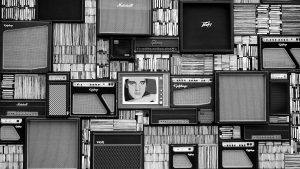
Initially, his work focused on how culture had transformed into a business. He provided examples of how print advertising was shaping this new mechanical, electrical world driven by immediate comfort and profit. His key point was that culture is to us as water is to fish—we exist within it. Only when we’re out of it, like a fish beached, can we recognize its absence.
What he observed in mid-twentieth-century print ads and then on television is nothing compared to what social media has done to our psyche. Our nervous system is attached to a 24/7/365 sensory pulse of everything going on in the world. We’re not built for that, and it is exhausting. But that’s not the worst of it.
Social media’s water is about the commodification of attention of all the fish. The sole purpose of social media platforms is to monopolize and monetize the attention of their users. We perpetuate this because we buy the stocks of Meta and Google, which then forces the management to further exploit our attention to drive more profits through advertising—the message of the medium of Money.
Yes, money is a medium as well. Money communicates what we value as individuals and as a society.
What message do you send to a potential customer by where, when, and for how much you offer your product?
For example, let’s say you choose to put your audiobooks on YouTube to monetize them.
YouTube wants you to think that you’ll make some money from advertising, and then those who discover your books will become paid customers. Seems fair…
Calculate your revenue by dividing the advertising revenue by the number of hours listened. That is the price at which you value your work.
What does it tell your reader about your story’s value?
This is the conundrum: You want to earn a living writing, and you want to take a stand on the value of your work.
But the medium’s message is that you need traffic to scale, and if you just get visibility, you’ll become rich.
So, I decide to do things like give social media platforms free content in the hopes of getting that promise fulfilled, thereby signaling to the market that my works are less valuable.

If you find the messages of social media and money incongruent with your brand, it may be time to establish your digital homestead.
McLuhan helped me be the fish that sees the water. In the early days of the internet, no one owned the networks. Underlying Facebook and Google, there is still that unowned internet. The problem is, as alluring and freeing as it may seem, going out on your own and building your digital homestead is hard.
Or is it…
What we are comparing is the message of the medium to the work of digital homesteading. The message is that if you just give us your content in the manner of our choosing, we will make you successful and profitable fast.
But that’s BS.
The numbers do not hold up in court. Popularity markets favor a few content providers and the market maker.
Yes, discovery will be harder when building your own digital homestead, but it’s your homestead. Here’s the dirty secret: Without your content, the market makers collapse.
I think a large part of what big tech is afraid of right now is how fragile their monopolies are. They have us in this prisoner’s dilemma that keeps them safe, and most of us won’t leave as long as they can keep selling us the message that they provide easy visibility.
However, a growing number of authors see the water and choose a different approach—one where they treat readers like valued participants in their experience instead of transactions. Yes, it will take longer, but the type of reader you will attract will be the one who values your work and sees your experience as distinct and better than authors and social media platforms who exploit them for their attention.