| How do you maintain creative continuity when everything around you changes? In 1666, Isaac Newton fled Cambridge University when it closed due to the Great Plague. Returning to his family home in Woolsthorpe, he found himself isolated, his normal academic routines shattered. During this disruption, without access to libraries or colleagues, Newton accomplished some of his most groundbreaking work—developing calculus, conducting his prism experiments, and beginning to formulate his theory of gravity. Newton’s story reveals something crucial about creative systems: when they’re properly designed, they don’t just function during ideal conditions—they can be adapted to thrive during times of disruption. Last week, we explored how to automate your creative systems to sustain momentum without constant conscious effort. But what happens when life intervenes with major transitions or unexpected crises? The Vulnerability of Systems During TransitionLife transitions come in many forms:
- Moving to a new home
- Changing day jobs or careers
- Family expansions or reductions
- Health challenges
- Financial shifts
- Seasonal changes
During these periods, even the most carefully designed creative systems often collapse. The environmental triggers disappear. Temporal frameworks shatter. Social automation breaks down. The cognitive bandwidth needed to rebuild these systems becomes unavailable precisely when you need them most. This vulnerability explains why many authors experience lengthy creative gaps following major life changes. They lose not just the external conditions that supported their work but also the automatic systems that maintained their creative momentum.
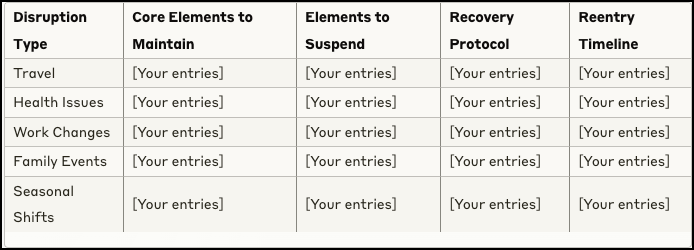
 The Three Principles of Adaptive SystemsDrawing from Chapter 10’s Skill Sculpting and Chapter 7’s Mood Mastery, let’s explore how to build creative systems that bend rather than break during life’s inevitable disruptions. 1. The Core-Satellite Principle Think of your creative practice as having an essential core surrounded by supporting satellites. The core contains the absolute minimum elements required to maintain creative identity. The satellites provide enhancement and optimization under ideal conditions. During times of disruption, you can temporarily shed the satellites while preserving the core:
- Identify Your Irreducible Core: What 2-3 elements of your creative practice are absolutely essential? Perhaps it’s 15 minutes of writing, regardless of conditions, or maintaining your idea capture system even when full drafting isn’t possible.
- Create Satellite Flexibility: Design your enhancement elements to function independently so they can be temporarily suspended without collapsing the entire system.
- Establish Clear Reduction Protocols: Decide in advance which elements to preserve and which to suspend during different types of disruption.
2. The Portable Triggers Principle While physical environments significantly influence our creative states, relying exclusively on fixed environmental triggers can leave us vulnerable during transitions. The solution is developing portable triggers that maintain creative states regardless of location:
- Sensory Anchors: Create small sensory cues (a specific scent, sound, or physical object) that trigger creative states independently of the environment.
- Ritual Portability: Design simplified versions of your creative rituals that can be performed anywhere with minimal requirements.
- Digital Environments: Establish virtual workspaces that maintain continuity across physical locations.
- State Induction Techniques: Develop internal methods (breathing patterns, mental visualizations) that activate creative states without external cues.
3. The Boundary Buffer Principle Most systems fail during transition because they lack appropriate buffers—space to absorb disruption without complete collapse. Building strategic buffers creates resilience:
- Time Buffers: Establish reduced-expectation periods around known transitions, preventing system abandonment due to temporary inability to maintain full practice.
- Capacity Reserves: Intentionally operate below maximum capacity during normal periods, creating reserves for disruption occurs.
- Recovery Protocols: Design specific practices that restore system functionality following disruption.
- Graduated Reentry: Create step-by-step processes for rebuilding full systems after temporary reduction.
Your Transition-Proofing Implementation PlanLet’s build resilience into your creative systems:
- Create Your System Hierarchy:
- List all elements of your current creative system. By this point you should have an interesting process map. Have you recorded it somewhere?
- Identify the 2-3 core elements essential to your creative identity
- Categorize remaining elements as primary or secondary satellites
- Create clear protocols for which elements to maintain during different types of disruption
- Develop Your Portable Triggers:
- Design at least three location-independent creative triggers
- Create simplified versions of your key creative rituals
- Establish digital continuity for your Progress Pulse system
- Practice internal state-induction techniques
- Build Your Boundary Buffers:
- Identify upcoming transitions and create buffer periods around them
- Establish your minimum viable practice for different disruption scenarios
- Design specific system restoration protocols
- Create a graduated reentry plan for rebuilding after major disruptions
- Anticipate Specific Transitions:
- Identify the three most likely disruptions you might face in the coming year
- Design specific adaptation strategies for each scenario
- Create emergency creative continuity plans for unexpected disruptions
- Prepare transition support tools in advance
The Adaptation MatrixTo make this process concrete, create an Adaptation Matrix for your creative practice: |