In 1987, Italian university student Francesco Cirillo was struggling with procrastination and overwhelm. His solution seemed almost too simple: a kitchen timer shaped like a tomato (“pomodoro” in Italian). By working in focused 25-minute intervals followed by 5-minute breaks, Cirillo discovered he could maintain concentration and productivity far longer than when attempting marathon work sessions.
This intuitive approach to microrecovery has since been validated by extensive research showing that our brains operate in natural ultradian rhythms—cycles of roughly 90-120 minutes where attention rises, peaks, and then naturally falls. Fighting these cycles diminishes creativity and increases errors, while honoring them enhances both output and quality.
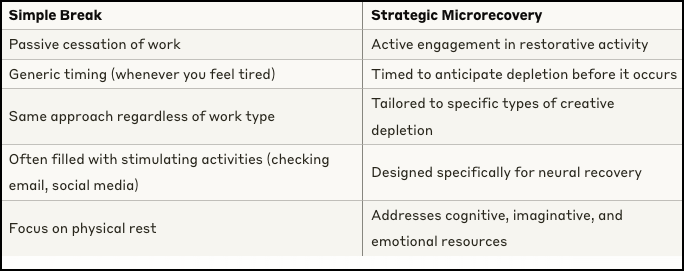
But there’s a crucial distinction between generic break-taking and what I call Microrecovery—strategically designed brief renewal periods that address specific types of creative depletion before they become severe.
Microrecovery vs. Simple Breaks
A simple break is passive: you stop working. Microrecovery is active: you deliberately engage in specific activities designed to restore particular cognitive resources. This distinction transforms these brief intervals from mere pauses into powerful catalysts for sustained creative performance.
Consider these differences:
The Science of Brief Recovery
Your brain’s Executive Function networks—responsible for focus, decision-making, and analytical thinking —operate using a limited resource pool that gradually depletes as you use it. Research by Roy Baumeister and others shows that this resource behaves much like a muscle: it fatigues with use but can be rapidly refreshed with proper recovery.
Meanwhile, your Default Mode Network (DMN)—crucial for creative connections and insights—becomes suppressed during focused work. Brief recovery periods allow it to reactivate, often generating solutions to problems you’ve been consciously working on.
This explains why solutions often emerge during breaks rather than intense focus—your DMN needs space to process information in its unique, non-linear fashion.
The Microrecovery Framework
Drawing from both neuroscience and practical application, here’s how to implement strategic Microrecovery in your creative practice:
1. Timing Optimization
Rather than arbitrary timing, optimize your work/recovery cycles based on your natural rhythms:
- Pre-Depletion Timing: Initiate recovery before noticeable fatigue (typically 25-45 minutes for deep focus work)
- Ultradian Alignment: Design longer cycles that honor your natural attention waves (roughly 90-120 minutes)
- Energy-State Adjustment: Shorten intervals during lower energy states and extend them during peak states
- Task-Based Calibration: Adjust timing based on cognitive demands (shorter cycles for intense analytical work)
The standard Pomodoro approach (25 minutes work/5 minutes rest) works well as a starting point, but your optimal timing may differ based on your personal patterns and the nature of your creative work. Start with shorter intervals and work up to longer ones.

2. Activity Matching
Not all recovery activities serve the same purpose. Match your microrecovery activity to your specific depletion type:
- For Executive Function Renewal:
- Brief meditation or breath focus (even 2-3 minutes)
- Gentle physical movement without decision-making
- Unfocused gazing at natural settings or distant horizons
- Complete sensory shifting (close eyes, focus on sounds)
- For DMN Reactivation:
- Physical movement
- Brief exposure to unrelated creative stimuli
- Intentional mind-wandering with time boundary
- Sensory richness (listening to complex music, feeling textured objects)
- For Emotional Replenishment:
- Brief gratitude practices
- Connection to purpose (rereading meaningful feedback)
- Physical gestures that change emotional state
- Micro-celebrations of progress
3. Transition Engineering
How you exit work and enter recovery dramatically affects its regenerative power:
- Clear Boundaries: Create distinct signals that mark the transition
- Completion Markers: Note specific re-entry points for returning to work
- Digital Disconnection: Fully separate from work during microrecovery periods
- Environmental Shifts: Change physical position or location even slightly
4. Technology Integration
Various tools can support effective microrecovery:
- Timing Systems: Beyond basic Pomodoro timers, apps like Forest, Focus@Will, or Focus Keeper offer customizable intervals
- Recovery Guidance: Apps like Calm or Headspace provide brief guided meditations designed for workday use
- Tracking Integration: Connect your microrecovery system to your Progress Pulse for pattern recognition
- Ambient Monitoring: Consider tools that track attention patterns and suggest recovery timing
The True Power of Pomodoro
While Francesco Cirillo’s Pomodoro Technique provides an excellent starting framework, its power comes not from the specific intervals but from three key principles:
- Preemptive Recovery: Taking breaks before you feel exhausted
- Complete Disengagement: Fully disconnecting during recovery periods
- Rhythmic Consistency: Establishing predictable patterns your brain can anticipate
The technique’s true genius is recognizing that sustained creative performance doesn’t come from endless pushing but from rhythmic alternation between engagement and recovery.

Your Microrecovery Implementation
This week, I want you to develop your personalized microrecovery system:
- Determine Your Optimal Intervals:
- Experiment with different work/recovery timing (start with 25/5, but test alternatives)
- Note which patterns work best for different types of creative tasks
- Identify your natural ultradian rhythm (when focus naturally rises and falls)
- Create Your Activity Portfolio:
- Develop 2-3 microrecovery activities for each depletion type
- Design activities requiring minimal setup or transition time
- Create environmental triggers that support each activity
- Establish Your Signaling System:
- Choose specific auditory, visual, or physical signals for transitions
- Create clear start/stop rituals for both work and recovery periods
- Design your workspace to support quick transitions
- Integrate With Your Progress Pulse:
- Note how microrecovery affects project movement across your board
- Track energy state changes following different recovery activities
- Identify which recovery approaches work best for different project types
Beyond Pomodoro: Advanced Microrecovery Applications
While the standard Pomodoro approach works well for implementation tasks, consider these advanced applications for different creative modes:
- Cascading Intervals: Gradually decreasing work periods (45/5, 35/5, 25/5) for sustained editing sessions
- DMN Sandwich: Brief creative breaks between analytical tasks to maintain access to both networks
- Emotional Anchoring: Scheduled micro-connections to reader feedback during challenging drafting sessions
- State-Specific Recovery: Different interval patterns for different brain states, allocating longer periods for flow states.
Looking Ahead
Next week, we’ll explore “Immersive Recovery”—the strategic use of extended, deliberately designed recovery experiences that spark breakthrough creative insights.
This Week’s Challenge
Implement your personalized microrecovery system for at least four working days. Document:
- Which timing patterns work best for different types of creative work
- How different recovery activities affect subsequent creative sessions
- How this approach changes your relationship with your Progress Pulse board
Remember, Francesco Cirillo’s humble kitchen timer sparked a global productivity movement not because it was complex, but because it honored a fundamental truth about human cognition. The most effective systems are often the simplest ones that align perfectly with our natural patterns. Your optimal microrecovery system might be equally straightforward—the key is finding the specific approach that aligns with your unique creative rhythms.