Last week, you practiced the sophisticated “no” and began distinguishing between Market Time pressure and Creative Time alignment. This week, we tackle the financial foundation that makes those sophisticated decisions possible: calculating your Minimum Viable Freedom (MVF).
The Scarcity Decision Trap
When authors make creative decisions from financial desperation, they consistently choose short-term Market Time opportunities that undermine long-term Creative Time development. Every “yes” driven by immediate financial pressure resets your creative compound interest.
Your 38 weeks of Upspiral practice have built something valuable: deep alignment between your creative process and authentic voice. But this alignment only translates to sustainable career success when you can make decisions from financial stability rather than scarcity.
What Is Minimum Viable Freedom?
MVF is the specific income level at which you can decline misaligned opportunities without financial stress. It’s not about wealth—it’s about having enough financial cushion to prioritize Creative Time development over Market Time pressure. This number is deeply personal and varies dramatically based on your life circumstances, but knowing your exact MVF transforms how you evaluate opportunities.

The Three Components of MVF
- Essential Living Expenses: Your essential monthly costs (housing, food, insurance, debt payments)
- Creative Investment Fund: Monthly allocation for professional development, tools, and creative projects
- Working Capital Buffer: The total savings needed to sustain 3-5 years of investment before reaching consistent profitability
The Uncomfortable Truth About Author Economics
Author careers typically require 3-5 years of consistent Creative Time investment before generating sustainable income. This isn’t failure—it’s the reality of building creative compound interest in a power law marketplace.
Your MVF calculation must account for this timeline, not the fantasy of immediate profitability.
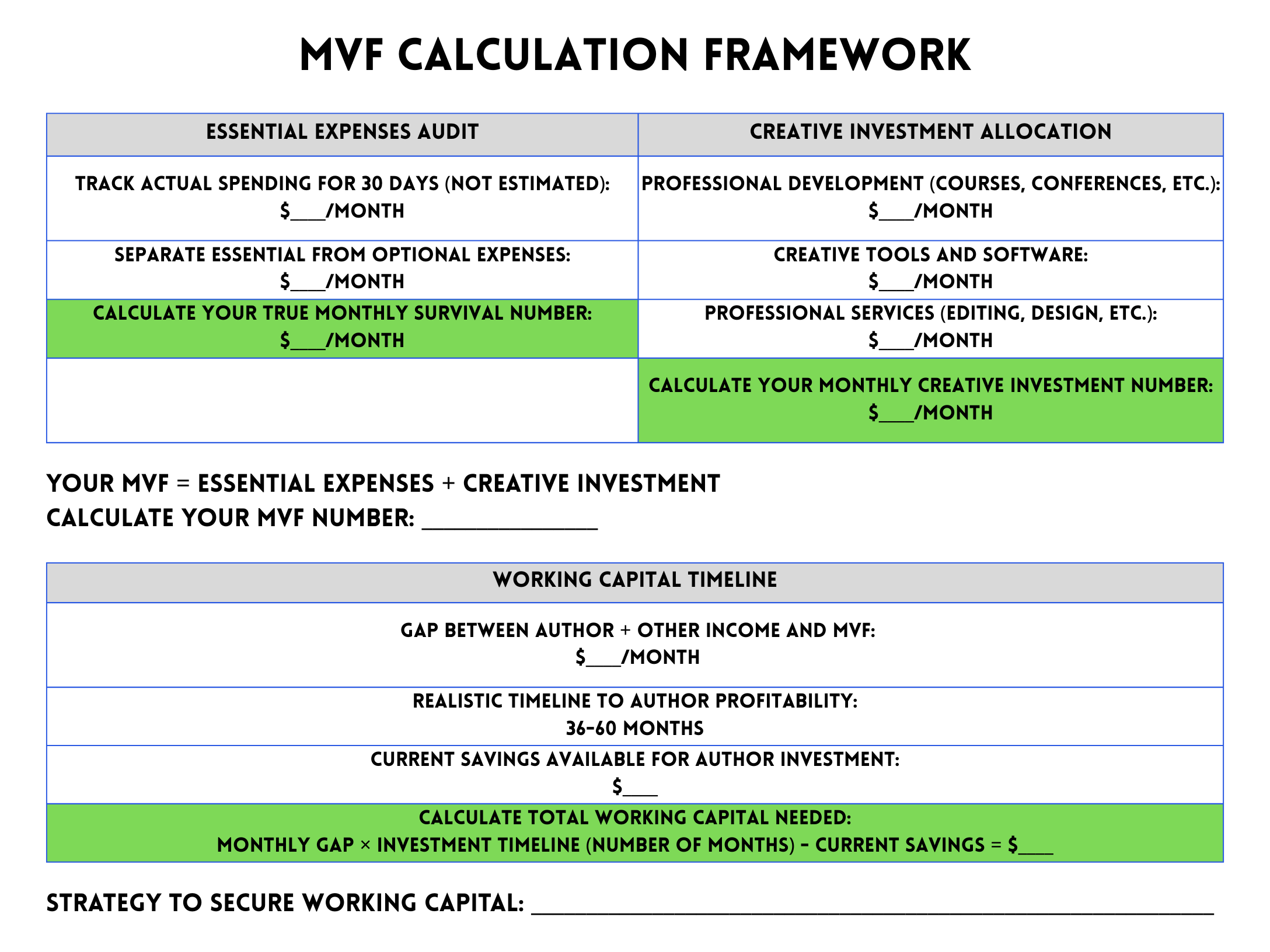
The Freedom Calculation Changes Everything
Once you know your MVF and working capital requirements, every decision becomes clearer:
- Sufficient Working Capital: You can prioritize Creative Time development and strategic patience
- Insufficient Working Capital: You need either cost reduction, timeline extension, or bridge income that preserves creative energy
- Building Working Capital: You can make strategic compromises while protecting core Creative Time investment
The Three Paths to Creative Financial Freedom
- Cost Reduction Path: Lower your MVF through lifestyle changes
- Timeline Extension Path: Reduce monthly gap by accepting longer profitability timeline
- Bridge Income Path: Secure working capital through Creative Time-aligned income sources
Case Study: The Reality of Creative Investment
Sarah, our thriller author, initially calculated her MVF at $4,200/month. Her author income averaged $1,800/month, resulting in a $2,400 gap that necessitated soul-crushing freelance work during her peak creative hours.
Instead of adding income, she ruthlessly audited her expenses:
- Moved to a smaller apartment: -$800/month
- Canceled subscriptions and services that didn’t serve her creative goals: -$300/month
- Reduced dining out and entertainment: -$400/month
- Negotiated lower insurance and utilities: -$200/month
Her new MVF: $2,700/month, requiring only a $900 gap to bridge. More importantly, she faced the uncomfortable truth about author careers: even with this reduced MVF, she needed 3-5 years of financial runway to build sustainable author income. Her calculation:
Working Capital Requirements:
- Monthly gap to cover: $900
- Investment period: 48 months (4 years)
- Total working capital needed: $43,200
- Current savings: $18,000
- Additional savings required: $25,200
This meant either securing additional working capital or extending her timeline to profitability. Before taking on new work to increase your income, consider the following assessment.
MVF-Aligned Income Strategies
Green Light Income (Supports Creative Time):
- Teaching skills you’re already developing
- Consulting in your area of authentic expertise
- Creating products that leverage your creative process
- Speaking about topics connected to your creative work
Yellow Light Income (Neutral to Creative Time):
- Part-time work outside creative hours
- Freelance services using different skills from your creative work
- Investment income or passive revenue streams
- Spouse/partner income that reduces your MVF pressure
Red Light Income (Competes with Creative Time):
- Freelance work that uses the same creative energy as your authentic work
- High-stress jobs that exhaust your creative capacity
- Work that demands your peak creative hours
- Income that requires you to suppress your authentic voice
This Week’s MVF Implementation

- Calculate Your Exact MVF
- Complete the three-step framework above
- Use actual numbers, not aspirational budgets
- Identify your current gap between income and MVF
- Income Stream Audit
- Categorize current income as Green/Yellow/Red light
- Identify which income sources support vs. compete with Creative Time
- Plan transitions away from Red Light income sources
- Gap-Closing Strategy
- Brainstorm Green Light income opportunities that leverage your creative expertise
- Calculate your timeline to reach MVF through Creative Time-aligned income
- Design intermediate steps to reduce scarcity-driven decision making
Looking Ahead
Next week, we’ll explore how to build your audience and platform in alignment with your natural creative rhythms, creating sustainable income growth that supports rather than competes with your authentic creative development.
This Week’s Challenge
Complete your MVF calculation and identify one potential Green Light income opportunity that could move you closer to financial creative freedom. This might be:
- A workshop teaching skills you’ve developed through your creative work
- Consulting services based on your authentic expertise
- A product that leverages your creative process
- A collaboration that enhances rather than distracts from your creative development
Reflection Question
How would your creative decisions change if you knew you could cover your essential expenses without compromising your Creative Time development? What opportunities would you pursue or decline differently?
Remember: MVF isn’t about getting rich—it’s about removing financial desperation from your creative decision-making process. Every step toward your MVF increases your ability to prioritize Creative Time compound interest.
Many authors discover that calculating their actual MVF reveals they’re closer to creative financial independence than they thought. Often, the freedom to make Creative Time decisions requires less income than we imagine but more clarity about what that number actually is.